A proposal to the CBAA boardChad Conley · License #1845390

Let's Clean Up Our Own House

Right now we're left with three choices: do nothing, join them, or do something. I'm choosing to do something.

There's some stuff going on in our industry right now that just isn't fair to the agents who play by the rules. Here's what I've found, and how I think CBAA can hold the line. This isn't a pitch for a seat. I'm doing the work either way. I'd just rather do it with CBAA.

Start here

Honestly, just press play. It reads you everything on this page, so you don't have to click through all the boxes below.

Read the PDF 17 pages

Why audio? Because it's easier in the car, or in the evening when you can't find your glasses (or your cheaters). If we loved reading pages and pages, most of us would've been attorneys.

Watch this first

Stop the Calls 6 min

Why cold calls to families put every licensed agent next to the phone scammers the whole country is cracking down on.

Open by itself

Sharing sends only the video, not this whole page.

The DOJ scam crackdown and what it means for bail calls

From Chad Conley, November 25, 2026. The written version of what's in the video.

What the Justice Department announced

On November 24, 2026, Attorney General Todd Blanche announced what the Department calls its largest-ever crackdown on scammers: over 400 cases against over 800 defendants since March 6 (DOJ). "Predatory scams against the American people will not be tolerated," Blanche said.

Three of the cases look a lot like what our families go through:

  • Arrest threats by phone. Georgia prison gang members used contraband cell phones to tell people they had missed jury duty and would be arrested unless they paid a "fine." 14 people were charged.
  • Spanish-speaking families targeted. A call center in Peru told Spanish-speaking Americans they had to pay or "they would be arrested or deported."
  • Phones inside jails. On November 19, the FCC approved a rule letting prisons and jails jam contraband cell phones.

Don't stand where the scammers stand

The Attorney General of the United States just stood at a podium and described a national wave of people calling strangers, telling them false things and taking their money. The country is now on alert for exactly that kind of call.

The scale is huge. The announcement says Americans lost an estimated $68 billion to scams in 2025, and 1 in 10 adults was hit by a scam directly or through someone in their household. The FBI says it has restrained nearly $17 billion in scam money (DOJ). Phone scams, investment scams and impostor scams are all under a federal spotlight right now.

A cold call to a scared family right after an arrest looks just like those scam calls. It comes from a stranger, at a bad moment, about an arrest, asking for money. The family can't tell the difference, and neither can a regulator or a reporter. Even when the caller is a real licensed agent, the industry ends up looking like the scammers.

The bail industry is supposed to be making itself look better, not worse. Does it really want to be looked at next to phone scammers and mortgage scammers, the people who take money over the phone with lies? Why would we put the bail industry in that position? Honest agents don't need cold calls. The industry should step out of that lane before someone else forces it out.

Why this matters to bail

Our customers get called at the worst moment of their lives. Someone they love was just arrested. They're scared and in a hurry. And the person on the phone can say anything:

  • They can give any name and any company.
  • They can claim to be licensed.
  • The family has no way to check while the call is happening.

We've already documented calls like this:

  • A caller who said she was a licensed agent named "Maria" hung up when asked for her last name.
  • A caller who started as a "nonprofit" ended by steering the family to a bail agent.
  • A caller texted a family about their son's arrest while Chad was at the jail posting his bond.

It cuts both ways

Agents can't see who's on the phone either. Every bail agent deals with this:

  • Cosigners who lie about who they are, where they work or what they own.
  • People with no ID on hand.
  • Someone sending in an application with a friend's ID, or a mother's ID taken from her purse, filled out in her name.

Without a way to check, all we have is trust. That's why Chad added the Fast Track ID check to his website: the signer uploads a photo ID and takes a selfie, so the face on the ID can be matched to the person actually signing. Families need a way to know who's calling them. Agents need a way to know who's signing. The answer for both is the same: identity you can check, not just trust.

The new law won't fix it alone

Starting January 1, 2027, Penal Code §538j (AB 1927) makes it a crime to falsely claim to be a licensed bail agent while soliciting, including by phone. It also covers whoever hires that caller (AB 1927).

That's a good rule. But on a phone call, a family can't see a badge or a license. They can't tell a real agent from someone who's only pretending to be one. The original bill CBAA sponsored would have banned unsolicited calls to arrestees' families. The final law was narrowed to impersonation.

Too many names is the same problem

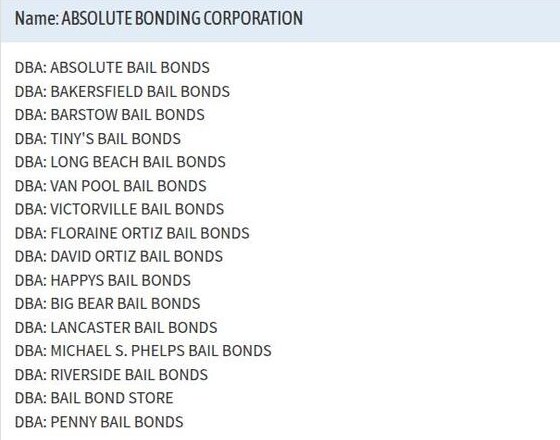
When one group advertises under dozens of names, a family can't tell who they're dealing with on the phone or online. The Absolute group's own records show 25 names across four licenses, plus more than 60 names on no license at all. A name that doesn't say whose company it is leaves the family unable to check who they're dealing with.

Chad's view

Why would the bail industry let itself stand next to these people?

The new law fell short. It only makes it a crime for someone to falsely claim to be a licensed agent on the call. That does nothing for licensed agents. When a stranger calls a family, nobody on the other end knows whether that caller is licensed or not. And every licensed agent takes the heat for it.

In my experience, most of the people making these calls are not bail agents. They don't represent us. They don't know the rules, regulations or laws, and they clearly don't care about them. They don't care about the family's privacy. They don't care who is crying or who gets hurt. They'll call an ex-spouse in the middle of a child custody fight and never think twice.

These callers hand out dirt. They tell people who were never supposed to know: enemies, ex-spouses, and the other side's lawyer in a divorce or custody case. That puts the bail industry in the middle of family fights we have no business being in.

"If I got arrested, I'd want them to call everybody"

Some agents say this. The argument goes: "I'm a good person. If I got arrested, I wouldn't remember anyone's number, so I'd want somebody calling my family to get me out." It doesn't hold up.

  • The arrested person already has calls. California law gives every arrestee at least three free local calls within three hours of booking, including to a bail agent and a relative. Custodial parents get two more to arrange child care (Penal Code §851.5). In my experience, police also let people look up numbers on their own phones these days. That didn't happen years ago.
  • Innocent people get hurt the most. Picture an agent who did nothing wrong, gets arrested anyway, and is in a custody fight. A stranger calls the ex-spouse. Now he gets hurt in family court before he ever gets his day in criminal court. Nobody would want that for himself.
  • No one with ethics would sign up for it. I've never met a bail agent who would want this done to his own family.

The bottom line

Nobody with common sense believes a family can identify who is calling them. As long as that stays true, these calls invite fraud. They invite the people who want to break the rules. And they let everyone else put licensed bail agents in the same class as the phone scammers the whole country is now cracking down on.

Is that really okay with us? The calls have to stop for the problem to stop.

What the board can do

  1. Finish AB 1927. Go back to the original goal: no unsolicited calls, texts or emails to an arrestee's family.
  2. Teach families to hang up and look it up. Get the agent's name and license number, then check it at the CDI website before paying anyone.
  3. Hold members to one true name. Every ad and listing should show the licensee's true name and license number, so a family can always tell who they're dealing with.
  4. Make ID checks standard. Encourage members to verify signers with a photo ID and selfie before writing a bond, so a borrowed or stolen ID gets caught up front.

The question

How do we get more members?

Everybody on the board asks it. Here's my answer.

When Trump first ran, he went after the farmers, the steelworkers and the union guys who felt like nobody ever heard them. They signed up and turned out like never before. I want to run that same campaign in our industry.

It's the kitchen-table issues. Love him or hate him, and this isn't about Republican or Democrat, that's what got him over the line. Hard-working, four-wheel-drive, flag-on-the-truck Americans showed up because somebody finally talked about the table they sit at every night.

So here are ours. There wouldn't be a kitchen without CBAA. There wouldn't be a table, and there wouldn't be a plate. CBAA saved all of it for us. When the whole industry was on the line, they fought for it with years of hard, unpaid work. We wouldn't be here without them, and I'm grateful for it. But I'm sitting at that table, and people who break the rules are taking the food off my plate. Being thankful for the table doesn't mean I sit there quiet while it happens. It means I get to say it: get your hands off my plate.

That's how we get the members back. Talk about the plate, and the agents who walked away will join, pay their dues and vote.

Bring the GOATs back. I'm talking about the guys who sit back. Ask them and they'll tell you CBAA is relevant and saved bail for all of us. They're right. CBAA has pulled through for every one of us, and we should all be on our knees thankful. But a lot of those same guys feel like nobody hears them on the things that hit their business every day:

CBAA has never been the police of the industry. I understand that. But why can't we have a department? Why can't we take that role on ourselves, so these agents get heard, the ones breaking the rules get cleaned out, and the people who work hard see that it matters?

Care about the issues they care about, and they'll join. Not more penny-loafer members sitting on a sales desk. The guys who are fed up with Google Maps and with "if you can't beat them, join them." Today they have nowhere at CBAA to take it. That's where I come in.

Holding the line

CBAA has more authority than it thinks

CBAA has respect, and the Department of Insurance listens to it. An ethics role is only as strong as we make it. Anyone who's done recovery work knows this: walk in with authority, and people listen. A lot of times we had to tell the police what we're allowed to do, and that still happens.

Picture a CBAA position that looks at a complaint and tells the Department of Insurance, "We looked at this, and we agree," or "we don't." The Department will pay attention to that, if it ever gets that far. And agents will know it too. Once people believe CBAA is watching, a lot of these problems start fixing themselves.

It works both ways. If an agent gets hit with fake reviews or fake complaints, CBAA can look into that too. CBAA can reach out to Google or the Better Business Bureau as CBAA, show what it found, and ask them to take down what's fake. That's backing our agents, not just policing them.

It shouldn't come down to doing nothing, or going straight to the Department of Insurance.

Three real examples

This is what we're up against

Here are a few real case examples. The audio can't show you this part. Tap an example to open the pictures, the audio and the paperwork. The sheer number of listings and names is a little shocking.

What you're looking at: this is what I found in public records, license lookups and Google listings, saved as screenshots. I could be wrong on some of it, and I'm not the one who decides whether anybody broke a rule. That's the Department of Insurance's job. You're looking at what I'm looking at.

Star Bail Bonds

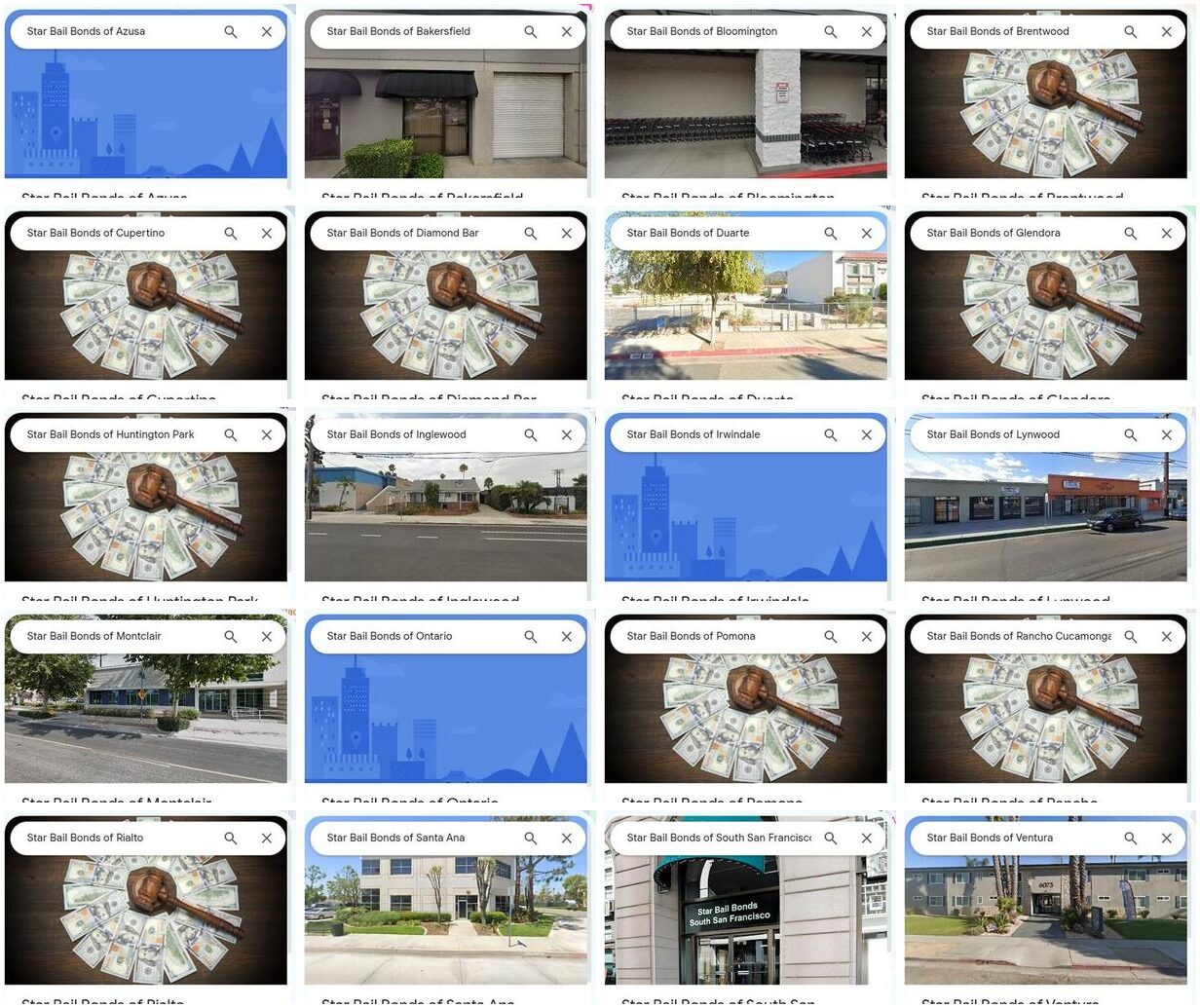
20 Google listings, and no licensee found behind them.

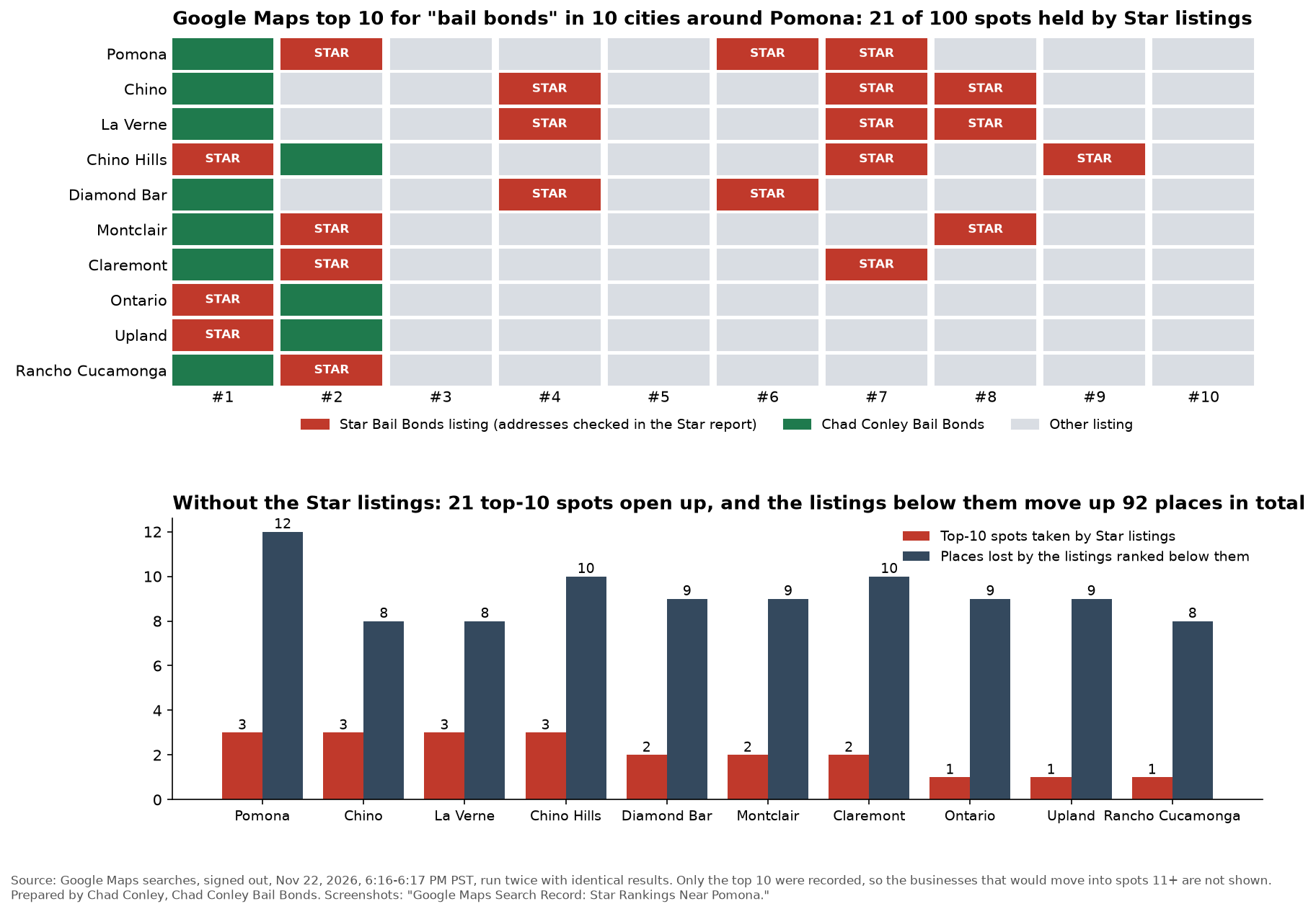
Across the 22 cities we searched, Star holds 41 of the 220 top-10 spots on Google Maps, and it's #1 in four of them.

Every one of these listings says "Open 24 hours." Every one points to the same website. Not one shows a license number, an owner or a description. The Department of Insurance license search for "Star Bail" comes back empty.

All 20 Star Bail Bonds Google Maps profiles

All 20 profiles, side by side

Captured from Google Maps on November 22, 2026. Different city names, same brand, same website.

No license number on any of them.

Google Maps top 10 in 10 cities around Pomona with Star listings marked

Where they show up

The Google Maps top 10 in 10 cities around Pomona. Star holds 21 of the 100 spots.

Those are spots that should go to real, licensed offices.

What customers wrote in the reviews

"This company does not exist here, it's an apartment building."Google review
"They are not really at that location."Google review
Calling them set off calls from several LA bail companies: "a lead funnel."Google review, paraphrased

The paperwork

Report to Google (24 pages)

Every profile, one by one, with the screenshot and the reason it breaks Google's rules for a real business.

Open PDF

Google Maps search record, 22 cities (47 pages)

The actual Maps searches, saved as exhibits, showing where Star ranks in each city and who would move up.

Open PDF

Bail Bonds DIRECT

Listed at my own office building. They've never been in it.

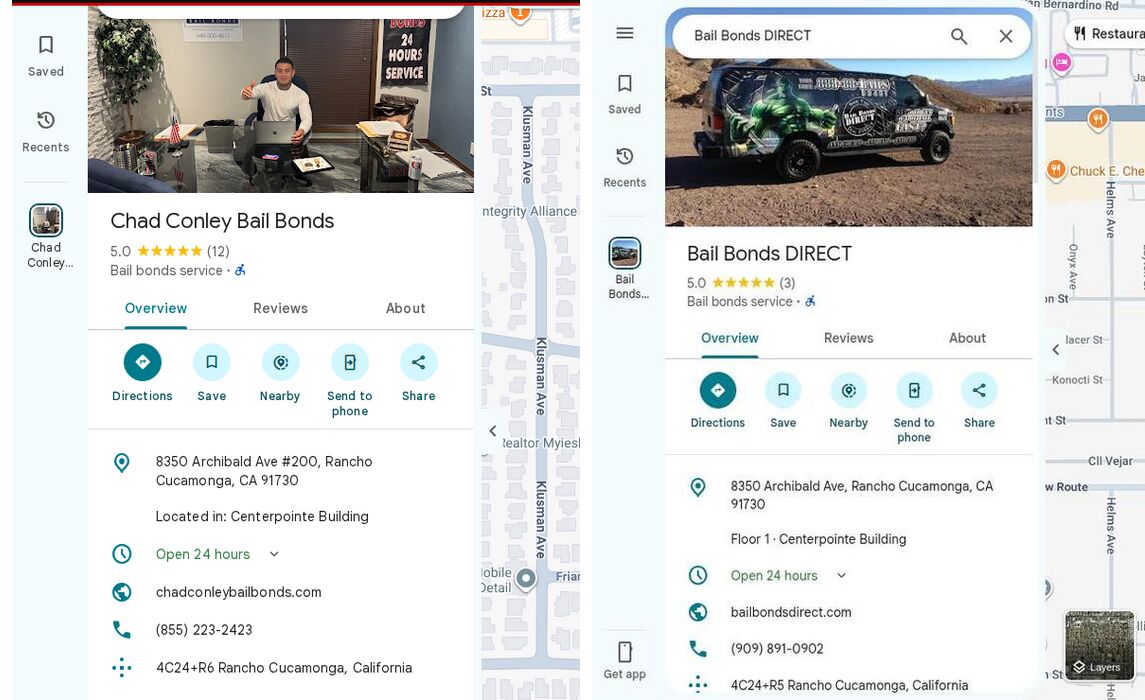
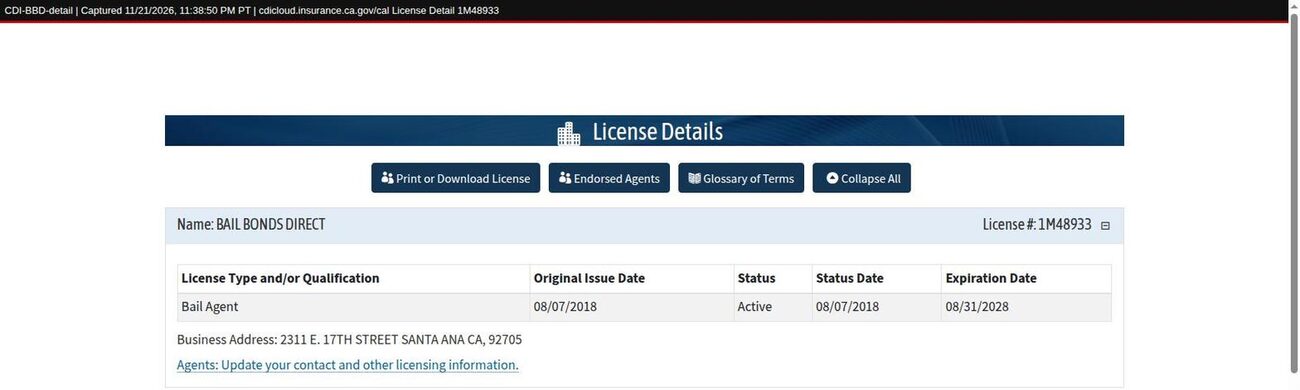
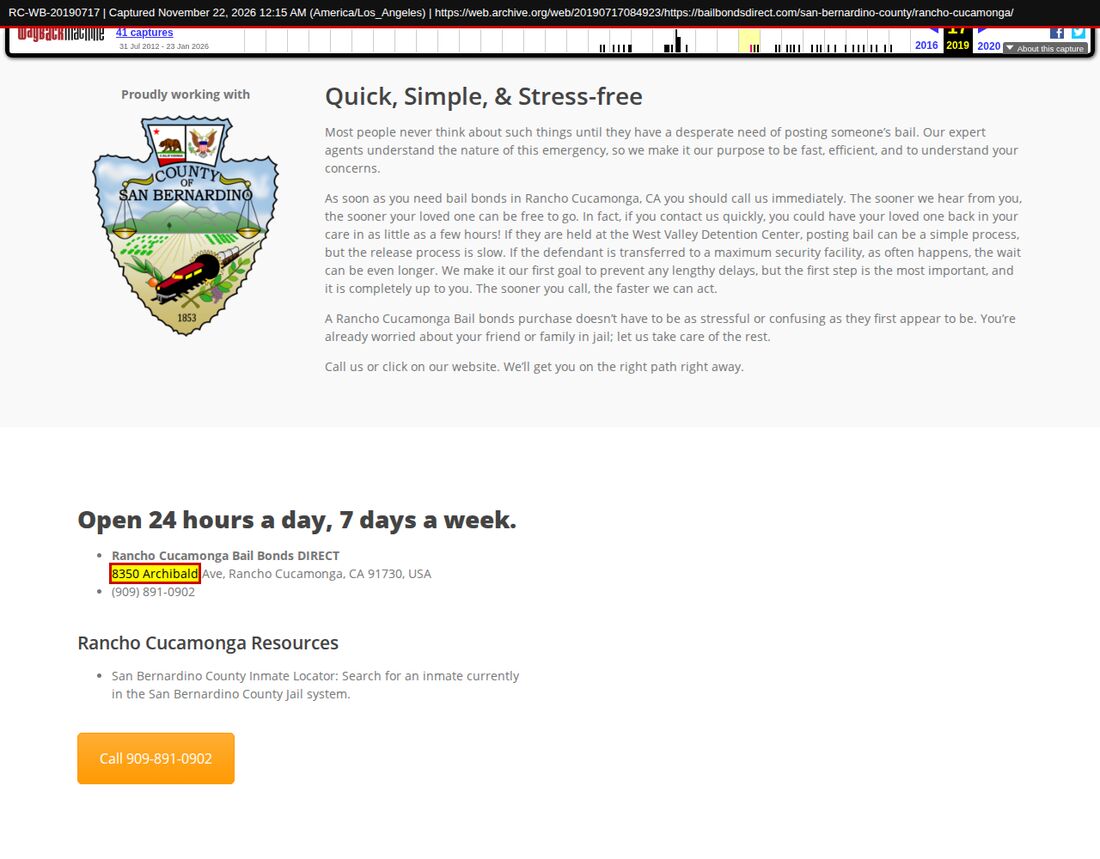
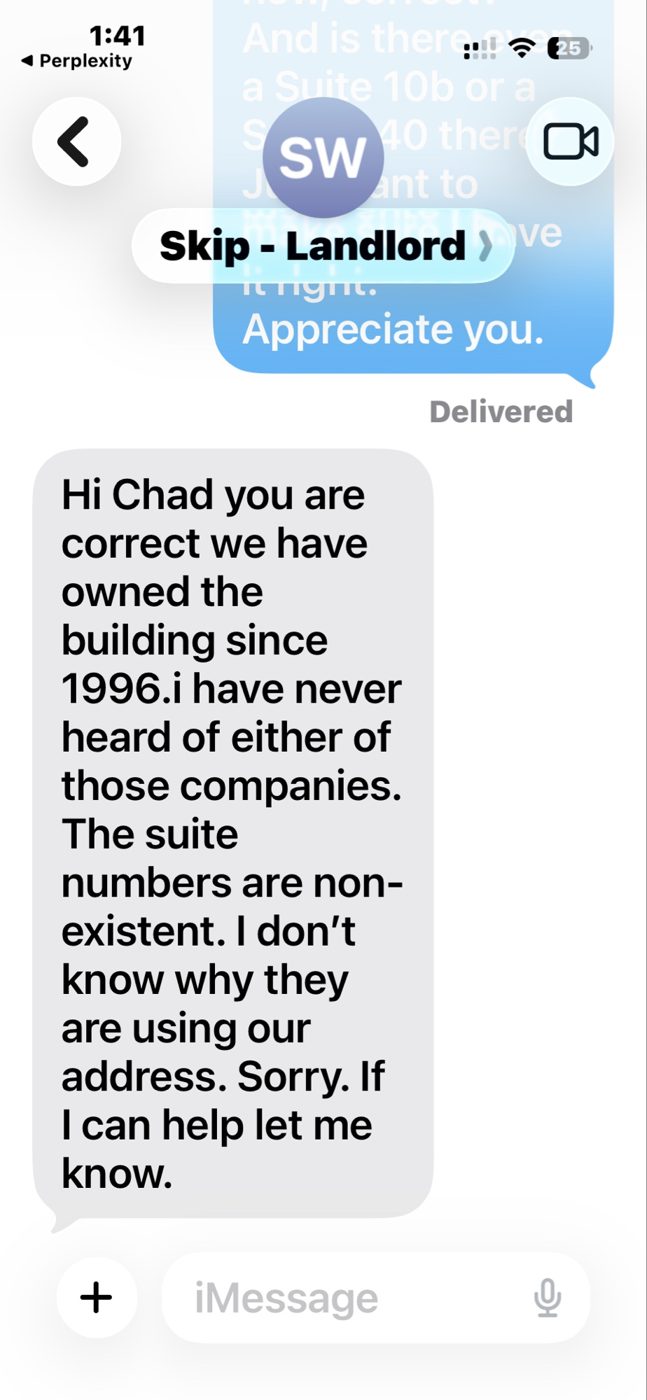
This one's at my front door. A Google listing for Bail Bonds DIRECT shows 8350 Archibald Ave, Rancho Cucamonga. That's my building. The building owner confirmed in writing that they are not, and never were, a tenant. Their Department of Insurance license (#1M48933) lists an address in Santa Ana.

I asked them at least three times over about a year to take my address off. They said they couldn't reach their web person. I haven't pushed it further. I don't want to turn people in, and I'd rather fix it agent to agent. That's exactly why this needs CBAA: when asking nicely doesn't work, an honest agent has nowhere to go but a complaint.

Chad Conley Bail Bonds and Bail Bonds DIRECT Google listings at the same address

Same building, two listings

Left: my office, Suite 200. Right: Bail Bonds DIRECT, "Floor 1, Centerpointe Building."

Only one of us has a desk here.

Department of Insurance license detail for Bail Bonds DIRECT showing a Santa Ana address

What their license says

The Department of Insurance has their business address as 2311 E. 17th Street, Santa Ana. Not Rancho Cucamonga.

Archived 2019 copy of the Bail Bonds DIRECT Rancho Cucamonga web page showing 8350 Archibald

Their own website, 2019

An archived copy of their Rancho Cucamonga page, showing "8350 Archibald." Archived copies show that address from 2015 through May 2025.

Text message from the building owner saying he has never heard of the company and the suite numbers do not exist

The building owner, in writing

November 22, 2026: "We have owned the building since 1996. I have never heard of either of those companies. The suite numbers are non-existent."

"LA Bail Bonds"

One phone call led to four licenses and more than 45 names.

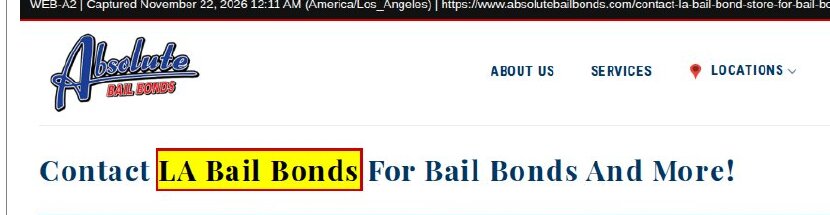
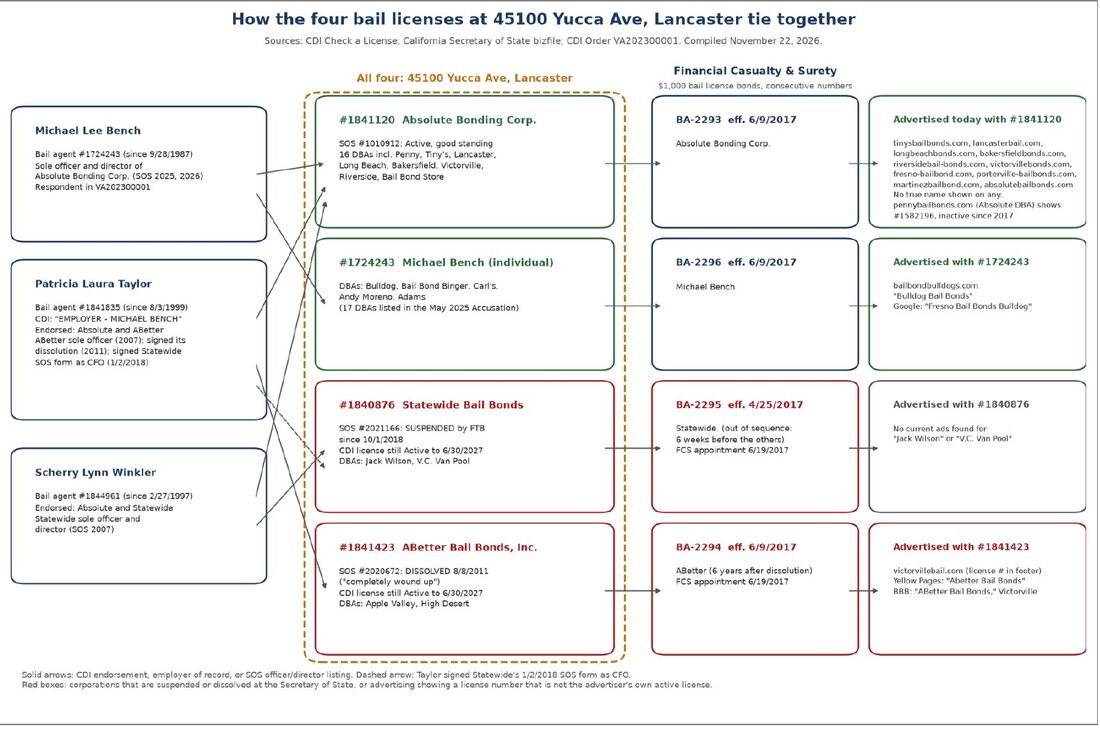
A cold call to a family at Pomona PD (more on that in Issue 2) used the name "LA Bail Bonds." There's no license by that name. Following it led to one group at one address in Lancaster: four bail licenses (one corporation suspended, one dissolved in 2011), 29 Google profiles under different local names, and about 36 phone numbers.

Where these names are on file: the Department of Insurance, not the county. That's four licenses, not 45 companies. The Department of Insurance's own license pages attach 25 business names (DBAs) to those four licenses, when the normal rule is one name per license. The other 20 are names they advertise that aren't on any of the four licenses. Some of those may be filed with the county. We haven't checked that yet.

The names, all from one address

On the four licenses at the Department of Insurance (25)Advertised, but not on any of the four licenses (20)
AbsoluteBail Bond StoreBakersfieldBarstowBig BearDavid OrtizFloraine OrtizHappysLancasterLong BeachMichael S. PhelpsPennyRiversideTiny'sVan PoolVictorvilleBulldogBail Bond BingerCarl'sAndy MorenoAdamsJack WilsonV.C. Van PoolApple ValleyHigh Desert LA Bail BondsLos Angeles Bail BondsAbsolute Los AngelesWest Los AngelesGlendaleSanta AnaOrange CountyVisaliaFresnoFresno BulldogPalmdalePalmdale BondsmanMartinez AbsoluteMartinezContra Costa CountyLynwood AbsoluteModesto AbsoluteSalinas AbsoluteSan BernardinoTulare

45 names here, and a few more in the report. Four licenses, not 45 companies. The normal rule is one name per license.

Department of Insurance license detail showing 16 DBA names

16 names on one license

This is the Department of Insurance's own License Detail page. One license, 16 DBA names. The normal rule is one.

The group's website using the name LA Bail Bonds

The name the caller used

"LA Bail Bonds," on the group's own website. It isn't on any of their licenses.

Chart of how the four licenses tie together

How the four licenses tie together

From the report: the same people, back-to-back bond numbers, and the brands advertised under each license.

They've been told before

In 2025 they admitted to the Department of Insurance that they advertised under a name the Department of Insurance hadn't approved, and agreed to obey the law. The same website was still up in May 2026.

To be fair: we don't know whether the caller works for these licenses. That's for the Department of Insurance to check. The name counts stand on their own.

The paperwork

Full report with exhibits, plus Supplement No. 1 (251 pages)

Every license record, Secretary of State record, Google profile and website screenshot behind the counts. You don't have to read it all. Start with the count table on page 4, then flip through to see how much there is. Supplement No. 1 starts on page 195: a statewide Google Maps review that found 51 listings tied to the group in 15 counties, 23 of them new, with 9 new counts. It's a big file (46 MB), so give it a moment on a phone.

Open PDF

Supplement No. 2: names beyond the limit (55 pages)

The name rule in one place: a bail license gets its true name plus one business name. The Department of Insurance's records show 25 names on these four licenses, against a limit of four, and the group's own pages and listings use more than 60 other names on no license at all. It also covers the 81-office "California Office Locations" page, where none of the offices shows the true name.

Open PDF

The tie chart (1 page)

One page that traces the names, phone numbers and licenses back to one address in Lancaster.

Open PDF

I'm not targeting anybody. I'm asking everybody to play by the same rules. These three are examples of what's going on out there, and they're just three out of many. Tap an example, then swipe through the pictures. Each one tells you what you're looking at.

This part is a no-brainer. Twenty profiles for one brand, with no licensee behind them, isn't a debate. Most agents already know it's wrong. Nothing happens because nobody has the time, some people are afraid to touch it, and who wants to put in all those hours and get nowhere? That's exactly why it needs CBAA's name on it. A report that comes from CBAA's ethics committee gets Google and the Department of Insurance to listen in a way one agent never will.

And you can see from how these are put together: with CBAA behind it, we'll put these cases together better than they've ever been put together, and get real results.

Laws already on the books

Two things we can fix right now

When I say there are laws on the books, here's what I mean. On cold calls, we don't have a law that's working yet. On two other things we do: the rules are written, and the authority is already there. That's Google Maps and Prop 103 rebates. And we've already found real cases for each one.

The cases below are what I found in public records, license lookups and Google listings. Whether anybody broke a rule is for the Department of Insurance to decide. These are the code sections that speak to what I found.

On the books now

1. Google Maps: one company, one name, real offices

One guy using 20 or 40 names to take Maps spots from honest offices isn't a gray area. The rules are already written.

What the law already says

  • A bail license gets its true name and one more name (a DBA). More names only by buying another licensee's business. Ins. Code §1724.5(e) §1821(b) §1802.2 10 CCR §2066
  • Every name has to be approved by the Department of Insurance in writing, and filed with the county, before it's used. 10 CCR §2066.3 B&P §17910
  • All advertising and phone listings show the true owner's name, with equal prominence, so it doesn't look like a separate business when it's the same owner. 10 CCR §2066.5
  • No advertising bail without a license. Ins. Code §1800.75
  • The license number goes on business cards, written quotes and print ads. Ins. Code §1725.5(a)
  • Every branch office has a licensee in charge of it, and every business address is reported to the Department. 10 CCR §2063.2 Ins. Code §1822 10 CCR §2095(e)
  • No untrue or misleading advertising, including on the internet. Ins. Code §790.03(b) B&P §17500
  • Breaking the bail chapter, or the Commissioner's bail rules, is a public offense. Ins. Code §1814

Where we've already found it

Star Bail Bonds.

20 Google profiles with different city names, one website, no license number on any of them, and the license search for "Star Bail" comes back empty. Reviewers say it isn't at those addresses. §1800.75 §1725.5(a) 10 CCR §2063.2 §2066.5

Bail Bonds DIRECT.

Listed at my building, 8350 Archibald, where the building owner says it was never a tenant. Its license lists Santa Ana. 10 CCR §2063.2 Ins. Code §1822 10 CCR §2095(e) B&P §17500

"LA Bail Bonds" (the Lancaster group).

Four licenses with 25 names on file, 16 on one license, plus 20 more names advertised that aren't on any of them, and 29 Google profiles. §1724.5(e) 10 CCR §2066 §2066.3 §2066.5 §790.03(b)

On the books now

2. Prop 103 rebates: legal, but done the right way

Rebates are legal. "A flat 5% to everybody, no questions, no haggling" over the phone isn't how the law sets it up. The rules are already written.

What the law already says

  • Each surety files its rates with the Department, and agents must charge the filed rates. A lower price is legal as a rebate under Prop 103. CDI Bail Bonds page Ins. Code §750(d)
  • No rate may be unfairly discriminatory. Same qualifying facts, same offer. Ins. Code §1861.05(a)
  • The agent pays the surety and the build-up fund on the filed rate the client qualifies for. Any rebate comes out of the agent's own commission. CDI bail pre-licensing objectives
  • An agent charges only the premium at the filed rate plus listed expenses, and gives a written statement of premium, charges, amount paid and balance. 10 CCR §2081 §2082 §2083
  • One premium per bond. Penal Code §1276.1
  • Misstating terms is an unfair practice. Ins. Code §790.03

What's going wrong

The 5% call.

In one call we documented this fall, a family was quoted a flat 5% of the bail. Nobody mentioned a rebate or explained the price. Families in the middle of paperwork now ask the agent they hired, "Why did I pay you 7%?"

Nothing on paper.

It's all verbal. Nobody can show what category the client qualified for, what was offered, or that the next family with the same facts got the same offer.

Where we may need more

3. Cold calls to families

Here's the honest part. The law says the caller has to be licensed, and starting January 1, 2027, it's a crime to pose as a licensed agent while soliciting (Penal Code §538j, from AB 1927). Nothing on the books stops a licensed agent from calling a family who never asked. That law isn't working for us yet.

I still believe we can change it. We can put it to a vote, make it a member standard, and stand together against the members who keep doing it. If that isn't enough, that's when we go get a new law.

So if we want to talk about what we can change right now, it's these two: clean up the Maps and make it fair, and teach Prop 103 the right way so the 5% haggling stops. Let's work on the laws we already have.

What's on this page

Three real examples

  1. ExStar Bail Bonds20 Google listings, and no licensee found behind them.
  2. ExBail Bonds DIRECTListed at my own office building. They've never been in it.
  3. Ex"LA Bail Bonds"One phone call led to four licenses and more than 45 names.
  1. §Laws already on the booksTwo things we can fix right now: Google Maps and Prop 103. The codes, and the cases where we found them.

The six issues

  1. 1Google MapsFake listings and lookalike referral sites taking calls from real offices.
  2. 2Cold callsStrangers calling families on the worst night of their lives.
  3. 3EducationTeach the basics openly. Compete on service.
  4. 4CBAA itselfA website that works, and a vote where every seat takes a position.
  5. 5Prop 103 rebatesOn the books now: legal and good, done the right way.
  6. 6Bond dropsA bigger conversation: the defendant should know who's posting.
  1. ★Bring the GOATs backThe good news: why the agents who feel unheard would join, if we take on their fights.

What I'm offering

A seat on the board, and a job on top of it

It isn't just the elephant in the room. It's the elephant with a monkey dancing on its back, clanging cymbals, and we all just stand there and let it happen. Everybody knows about the fake Google listings. Everybody knows the fill-in-the-bubble renewal course doesn't help anybody. You own a company, you list your company, and when a family calls, it should be a real company. Big or small, we don't have to be haters. So I'll ask you: didn't you say you want our industry to do better?
Read it pages 1–4

Sit back and listen, or open the pages and follow along while it plays.

1

Google Maps

Google has banned bail ads since 2018, and Facebook did the same. We can't buy our way onto the page anymore. So for most of us, the free Google Maps listing is where families find us at 2 a.m. Whoever fills those few top spots gets the call.

Fake listings with no real office and no license behind them are taking those spots from honest offices. And it isn't only fake listings. Watch for the ".org" lookalikes: websites set up to look like a charity or a helpline that pass the call to whoever pays for it. The family never knows who they're really talking to.

My position: if you advertise on Maps, have a real staffed office, use your licensed name and show your license number. Same rule for everyone, me included.
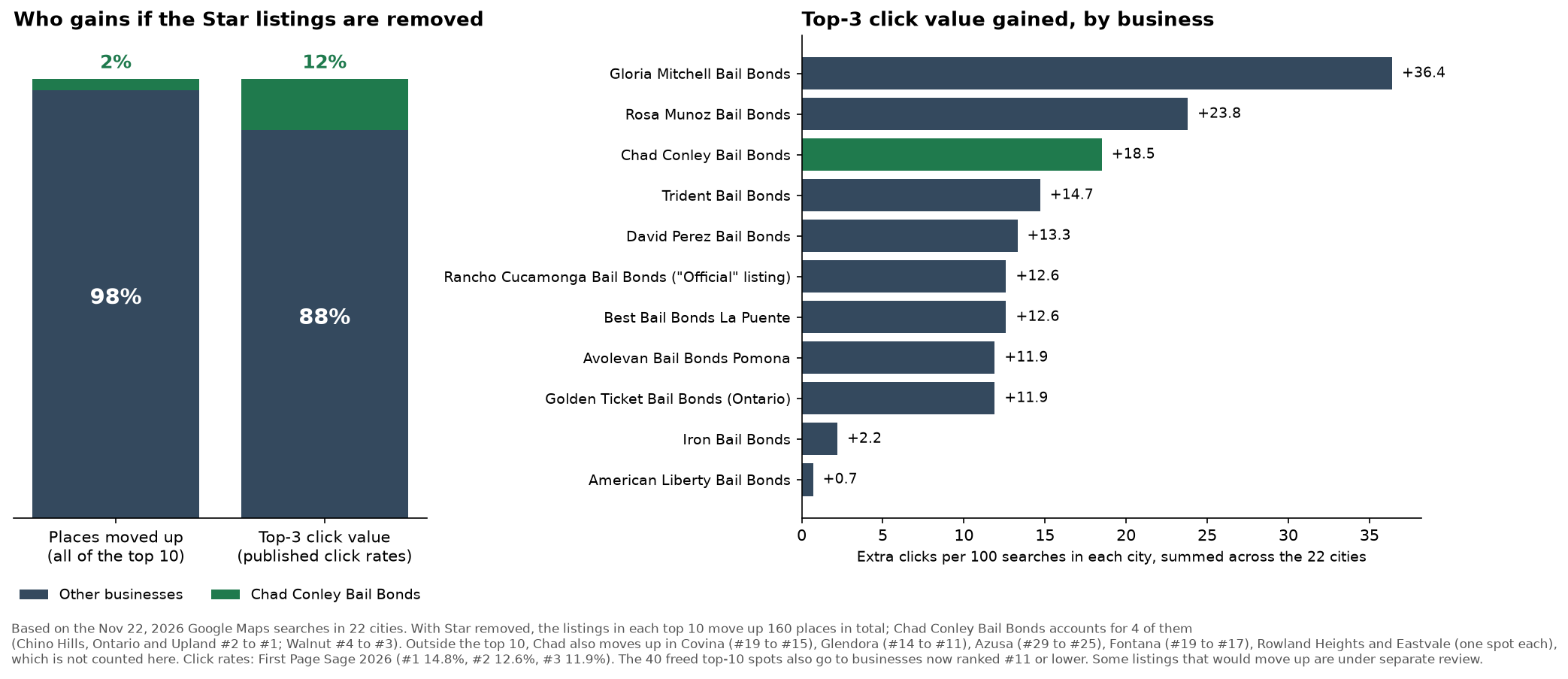
Here's what it looks like. One brand, Star Bail Bonds, shows up in the Google Maps top 10 in 20 of the 22 cities we searched around Pomona. In Azusa it holds 4 of the 10 spots. In six cities it holds 3, and in six more it holds 2. It's #1 in four cities, and #1 or #2 in eleven. Reviewers say it isn't even at those addresses. It has about 20 of these listings, and every place it puts an address, it's doing it to the honest offices right around it.
Chart: who moves up in 22 cities if one brand's listings are removed

This isn't about my rankings. If one brand's listings came down in 22 cities near Pomona, about 98% of the spots gained would go to other offices. About 2% would go to me.

What I'd ask CBAA to do

  • Same as print. It's that simple. On Google Maps, the company name is the company's real name, the address is the real address, and the license number is the real license number.
  • Want another company? Do it legit. If you want that to be the name of your company, go open another company with that name. If you really have a different office at a different address, list it.
  • No more one guy looking like five companies. No more listings called "Orange County Bail Bonds" or "Bail Bonds Orange County" to grab a city search. When one guy makes it look like there are five companies, you're suddenly only one-fifth or one-sixth of what's out there. He's competing against himself and you, to take it all. We all see it every day, and it's unfair.
  • A standard we agree on, not a new law. I'm against adding new laws. Let's agree on this ourselves as an industry standard every member signs on to.
Read it pages 5–10

Sit back and listen, or open the pages and follow along. The three real examples are at the top of this page.

2

Cold calls to families

A family was at Pomona PD with the agent they'd hired when the father's phone rang. The caller said he was the licensed agent with "LA Bail Bonds." There's no license by that name, and no licensee by the name he gave.

That's the real problem: nobody can tell who's on the other end of the phone. A first name and a company name prove nothing. Anybody can make a hundred calls and say they're me, and I'm the one who looks bad.

My position: stop the cold calls. Anyone who calls a family about a bond gives their full name and license number, every time. No license number, no conversation.

What I'd ask CBAA to do

  • A member ethics standard: no calls to families unless they asked.
  • Finish what AB 1927 started. The final law covers impersonators only.
Read it page 11

Sit back and listen, or open the page and follow along.

3

Education

Nobody in this industry wants to teach anybody anything. Everything gets treated like a trade secret. Meanwhile, more of the people coming in sell used cars half the day and bonds the other half, in penny loafers, and it's only about the money. That's not who we are. And under California law, how a jail processes bonds or what paperwork a court wants isn't a secret. It's know-how anyone can learn.

My position: teach each other again. Practical classes from agents who've done it all: writing, court, jails, recovery. Keep competing on service, speed and relationships. In bail, the GOATs are us, the ones who do it all. If we don't teach the next generation, the sales desks will.

Read it page 14

Sit back and listen, or open the page and follow along.

4

Fix our own house: CBAA itself

CBAA does the big work. It fights the big fights and keeps bail alive. This is a different category, and it doesn't take anything away from that. It's about the working agents who feel like their voice doesn't count anymore.

Every seat takes a position. If there are 12 board members, is it 10 to 2, or 2 to 10? Even if the votes are anonymous, we should at least know the count. And every voice should count the same, whoever the bigger donors or sponsors are.

The website. The education page has said the portal is "in the process of updating" since 2020. That's six years. And when I joined, I had to scroll through every country in the world to find the United States. Other members have noticed too.

Look at the page you're on right now. I built it in days, and it works on your phone. That's what cbaa.com could look like. Give me the okay and I'll have a private preview of a new site ready for the board in days, not months, with nothing changed on the live site until the board approves it.

What I'd do, with the board's okay

  • Rebuild the website and payments, private preview first.
  • Start a CBAA Facebook group for working agents.
  • Set up anonymous voting so every board member and every member takes a position.
Read it page 14

Sit back and listen, or open the page and follow along.

On the books now

5

Prop 103 rebates, done right

Rebates are legal and good for clients. But they've turned into haggling: a flat 5% quoted over the phone with no qualifying questions, and the next family pays more for the same bond. It's all verbal, so nobody can prove who was offered what.

My position: teach every agent to do rebates correctly, under the surety's filed plan, with a short signed rebate receipt in the file. It protects the client, and it protects the honest agent if the Department of Insurance ever asks.

How I believe it works: Chad's 180

  • First, face the surety. Figure out which filed category the client really qualifies for, and get the proof. That decides what you owe the surety and the build-up fund. You don't get to invent a category.
  • Then turn 180 degrees and face the client. Out of your own commission, do you offer a rebate? If you do, it's written, it has a start and end date and stated qualifications, and every client who meets them gets the same offer.
  • Put it on paper. A rebate receipt in every file: the filed rate, the rebate, what the client paid, and the client's signature.

The law behind it

Listen, read, take the course

The course is free on my website. Take it, question it, and check it against your own surety and your own attorney. It's my view of how it should be done, not legal advice.

One bigger conversation

Important to me, and worth taking slow

This one matters a lot to me. It's also a bigger talk with a lot of opinions in the room, and I'm not asking anyone to settle it overnight. I'm putting it on the table so we can work through it together.

6

Bond drops, and the defendant's choice

Today the officer tells the defendant, "Somebody's here to bond you out." Everyone says yes, because nothing is worse than sitting in jail. That includes a domestic violence victim being bailed out by the person they just accused.

Safe Release is one signed cover sheet the agent sends the jail before posting: agency, agent name and license number, and who asked for the bond. No money on the sheet. If two sheets come in, the defendant picks. Nobody is held longer than booking already takes.

My position: the agent the family actually called should post the bond, and the defendant should know who's posting. It's about protecting victims and the community.

Read it page 12

Sit back and listen, or open the page and follow along.

What we stand for

The Bail Agent's Creed

When everything falls apart, we're the ones who pull it together.

Defendant, family, cosigners, attorney, court: we get them all in position.

We guide the accused through the storm, trusted with everything.

In the panic, we bring relief to every mother, father, wife, husband, and child.

Like a lieutenant on the battlefield, we're close enough to see the chaos and steady enough to lead through it.

We stay strong for them and calm in their chaos, and when we have to, we hold the line.

We put it all on the chopping block, for the one in the robe and the lady with the torch.

That's the job. That's what we do.

Written by Chad Conley

Let's clean up our own house.

I've already started. Three case files are built, and the reports are ready. It'll hit a lot harder with CBAA behind it. I'm not here to argue with anyone. I'm offering my help.

Isn't this what we all want? Let's do it together.

Chad ConleyChad Conley Bail Bonds · License #1845390